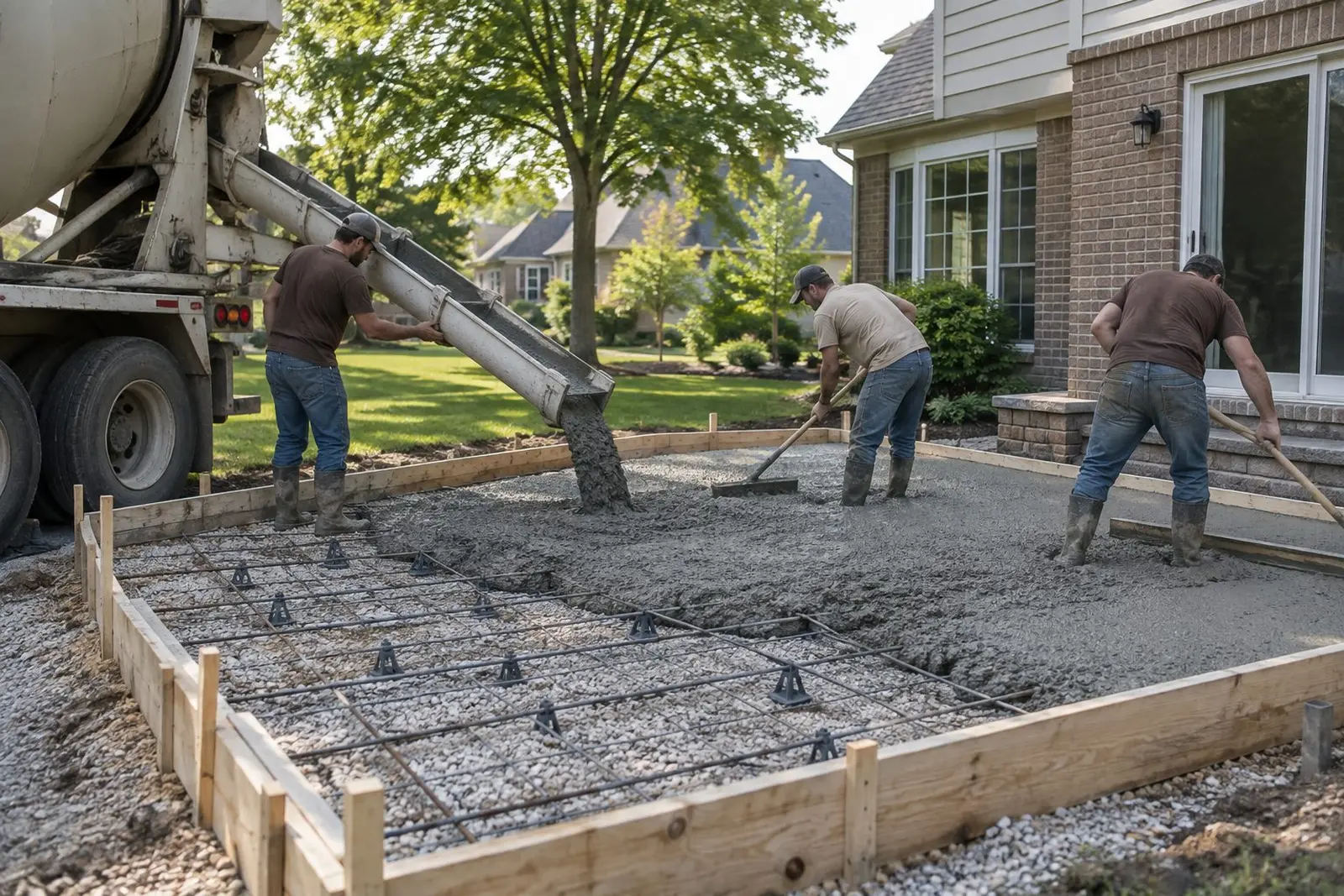
For most Indiana homeowners, the best time to pour concrete is when daytime temperatures sit roughly between 50 and 80 degrees and the ground has fully thawed. That usually points to late spring and early fall. Summer works too, with some planning. Golden Paw Concrete pours March through November, and the exact date for any job, from concrete driveways to patios, depends on the forecast that week.
Why Temperature Matters on Pour Day
Concrete doesn’t harden by drying out. It hardens through hydration, a chemical reaction between cement and water. Heat speeds that reaction up. Cold slows it down.
Too cold, and the slab gains strength slowly while the water in the mix is at risk of freezing. Ice expands. A surface that freezes in its first days can flake and scale for years afterward. Too hot, and the concrete can set before the finisher is done, leaving a patchy broom texture or a stamp pattern that didn’t press cleanly. Fast surface drying also brings fine shrinkage cracks.
The Best Time to Pour Concrete, Season by Season
- Early spring (March to April): Pours are possible once the frost is out of the ground, but cold nights and rain move dates around. Wet clay soil also has to firm up before forms and sub-base go in.
- Late spring (May to June): Mild days, cool nights and long daylight. Calendars fill fastest here.
- Summer (July to August): Very workable with early starts, a dampened sub-base and careful curing. Hot, windy afternoons are the real risk.
- Fall (September to November): Steady, moderate temperatures make early fall excellent. By November, overnight lows decide how a fresh slab has to be protected.
- Winter (December to February): We don’t pour. It’s planning season.
Pouring Concrete in Cold Weather
Industry guidance generally treats air temperatures below about 40 degrees as cold-weather concreting. Pouring in those conditions takes extra steps: heated water, set-accelerating admixtures, insulated blankets and days of protection. Commercial crews do it when a schedule demands it. For a home driveway or patio, though, a slab that freezes early can lose surface strength for good.
Golden Paw Concrete pours only from March through November, so every new slab gets milder days to gain strength. Fresh concrete also needs time before it faces freeze-thaw cycles and road salt, which our guide to de-icing salt and concrete explains.
Rain, Wind and Other Pour-Day Factors
Temperature isn’t the only variable. Rain on a freshly finished surface can wash away cement paste and weaken the top layer. A heavy storm the day before can turn a prepared sub-base into mud. Strong wind pulls moisture out of the surface faster than the crew can finish it.
A careful contractor reschedules instead of rushing a finish into bad weather. Expect a pour date to shift a day or two now and then, especially in spring. It’s a small delay compared with living with a weak surface.
Why Winter Is the Time to Plan
Estimates and planning happen all year. A winter consultation lets you settle the layout, the slope and the finish, whether that’s a classic broom texture or stamped concrete, before the season opens. Every estimate comes as a written, itemized scope, and you can ask about financing at the same visit.
Booking early helps you get on the calendar once pours start in March. We can’t promise a specific start date months ahead, because weather sets the pace. Our process page walks through every step from estimate to final walkthrough.
It also helps to think about how you’ll use the space. A patio poured in May is ready for summer evenings outside. A pool deck usually works best before or after swim season. A driveway is easier to live without for a week when you’re not juggling holiday guests or a fall full of school runs.
Can concrete be poured in an Indiana winter?
It can, with cold-weather measures, but Golden Paw Concrete doesn’t pour from December through February. Winter is a good time to get your estimate and plan a spring project.
Is fall a good time to pour a driveway?
Often, yes. September and October tend to bring steady temperatures, less heat stress on the finish and drier ground than early spring. The main caution is late in the season, when overnight lows start to dip toward freezing.
Does a cool fall day slow down curing?
Yes. Cooler temperatures slow hydration, so a slab poured in late October may need a little more time before it carries a car than one poured in June. Your crew will tell you what to expect.
Plan Your Pour With Golden Paw
Thinking about a new driveway, patio or walkway? Golden Paw Concrete pours across Indianapolis and nearby towns from March through November, and we give estimates year-round. Call or text (317) 672-0966 or request a free estimate, and we’ll talk through timing for your project.