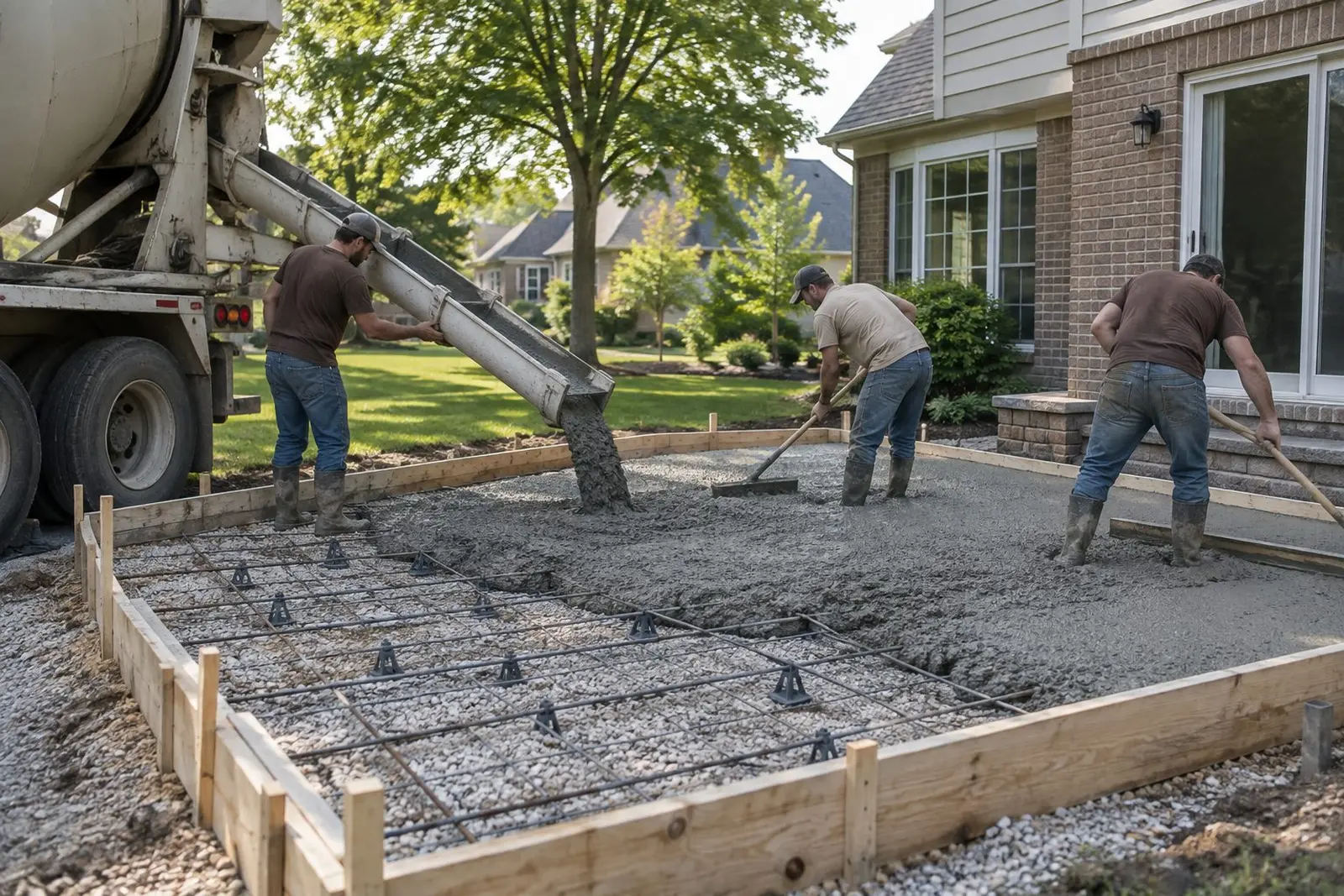
Ask three contractors about concrete driveway thickness and you may hear three different answers. That isn’t always a red flag. The right thickness depends on what will drive on the slab, the soil under it and how the base is built, and reinforcement is a separate decision on top of that. This guide covers the general industry thinking so you can read a concrete driveway estimate with confidence and ask sharp questions at the consultation.
Concrete Driveway Thickness: What Most Homes Need
For a typical home driveway carrying cars, SUVs and pickups, 4 inches is the common industry minimum and 5 inches is a frequent step up. Heavier use changes the math. If a box truck, a loaded trailer or an RV will park on the slab, many contractors go to 6 inches in those areas. Added thickness is one of the most effective ways to carry more weight, because a slab gets much stiffer with each extra inch.
Edges matter too. The outer edge of a driveway has no neighboring slab to share the load, so it’s where tires tend to snap off corners. A thickened edge helps. So does enough width that tires stay off the edge in the first place.
Patios, Walkways and Garage Floors
Not every slab needs driveway thinking. Patios and walkways that only carry feet and furniture are commonly poured around 4 inches. A garage floor usually lands in the driveway range, since it holds the same vehicles. A hot tub, an outdoor kitchen or a heavy pergola post may call for a thicker section or a separate footing under that spot. Mention any of those before the estimate. After the pour is too late.
Rebar vs. Wire Mesh vs. Fiber
Reinforcement does not stop concrete from cracking. Concrete shrinks as it cures and moves with every freeze-thaw cycle, so some cracking is normal. What reinforcement does is hold the pieces together, keeping a crack tight and both sides level. Our guide on why concrete cracks in Indiana covers the causes.
- Rebar: steel bars tied in a grid and set on supports, called chairs, so they sit inside the slab instead of on the dirt. Common on driveways, aprons and anything carrying heavy loads.
- Welded wire mesh: a lighter steel grid. It only helps if it ends up inside the concrete. Mesh trampled flat against the ground during the pour does very little.
- Synthetic fibers: mixed into the concrete at the plant to help control small shrinkage cracks near the surface. Many contractors use fibers alongside steel rather than instead of it.
Which option fits depends on the load and the soil. Ask any contractor what they plan to use and why.
The Sub-Base Does Half the Work
A thick slab on soft ground still fails. Central Indiana clay holds water, swells, shrinks and heaves when it freezes. That’s why well-built flatwork usually sits on a layer of compacted crushed stone that drains and gives the concrete an even bed. Soft spots, old tree roots and loose fill near the foundation need attention before the forms go up.
Water is part of the same conversation. Water trapped under a slab is what frost heave feeds on, so a downspout emptying onto the driveway can undo a good base. If water pools near your house, read our drainage and grading guide before you plan the pour.
Strength, Air and Control Joints
Concrete strength is measured in PSI. Residential flatwork commonly uses mixes in the 3,000 to 4,000 PSI range. Outdoor slabs in a freeze-thaw climate also benefit from air-entrained concrete, which holds tiny air bubbles that give freezing water room to expand. That matters in Indianapolis. Winter here means road salt and dozens of freezes and thaws.
Control joints are the planned cuts or tooled lines across a slab. They give cracks a place to form in a straight, tidy line. A common rule of thumb spaces them, in feet, at two to three times the slab thickness in inches, so a 4-inch slab gets joints roughly every 8 to 12 feet. Joints spaced too far apart are one of the most common reasons a new driveway cracks in random places.
Questions to Ask Before You Sign
- How thick will each area be, and will any section be thickened?
- What reinforcement goes in, and how is it kept up off the ground?
- What base goes down, and how deep?
- Where will the control joints go?
Get the answers on paper. A clear written scope of work is the easiest way to compare bids that otherwise look alike.
Does thicker concrete crack less?
Thickness helps a slab carry weight without breaking, but it won’t stop shrinkage cracks. Control joints, a solid base and good drainage do more for crack control than an extra inch alone.
Can reinforcement be added to an existing slab?
No. Steel and fibers have to go in when the concrete is poured. If an old slab is failing because it was too thin or unreinforced, replacement is usually the fix.
Plan Your Slab With Golden Paw
At Golden Paw Concrete, the in-person consultation is where these details get settled. We look at the ground, ask how you’ll use the slab and explain the options in plain terms. Then you get a written, itemized scope, so you know what’s being poured before anything is scheduled. Call or text (317) 672-0966 or request a free estimate to start planning.