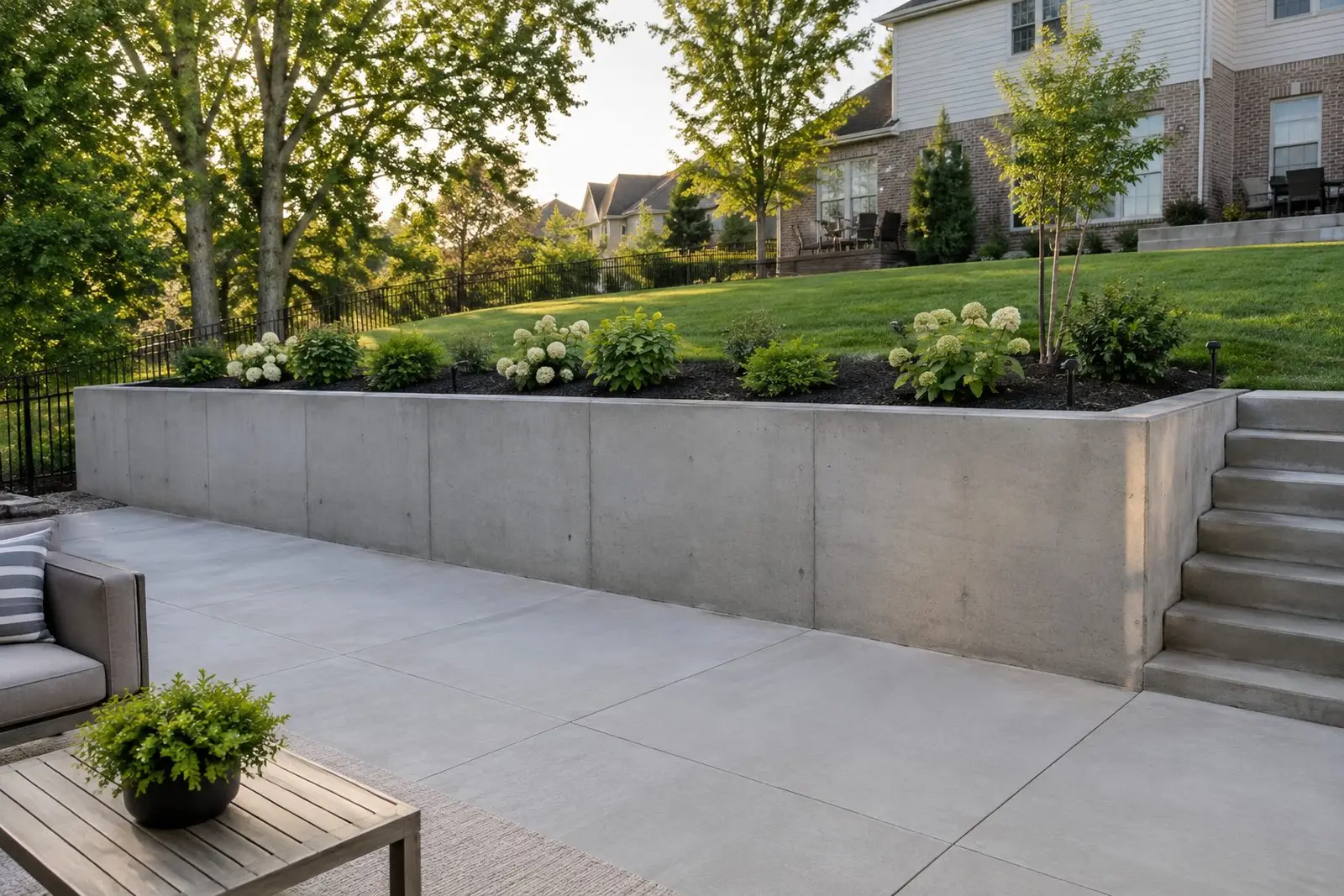
Water causes more concrete trouble than almost anything else. Good concrete drainage starts before the first form board goes in, with a plan for where every bit of rain and snowmelt will go. This guide covers planning a new pour. If water already sits on an existing slab, our post on fixing standing water covers repair options.
Why Concrete Drainage Matters
Water that pools on a slab freezes into ice patches in winter. It carries salt brine into the surface and speeds up scaling. Water running toward the house can end up against the foundation or in the basement.
Water under the slab is worse. It softens the sub-base, makes clay soils swell and can wash out fine material until voids form. Then the slab settles, tilts or cracks. Indianapolis gets plenty of rain and plenty of freeze-thaw cycles, so drainage isn’t a detail you can skip.
Slope: How Much Fall a Slab Needs
Flat concrete isn’t really flat. A slab needs a gentle slope, called fall, so water runs off instead of sitting. A common rule of thumb for flatwork is about 1/8 to 1/4 inch of fall per foot. Treat that as general guidance. The right slope depends on the site, the surface and how the slab will be used.
- Patios and walkways: slope away from the house.
- Driveways: usually toward the street or to one side, never toward the garage.
- Garage aprons: away from the door, so water doesn’t run inside.
- Pool decks: away from the pool and toward drains or open ground.
Too much slope has its own problems. Patio chairs wobble, and walking feels awkward. A good layout balances runoff against comfort.
Existing heights limit the options too. A new patio has to stay below the door threshold, and a driveway has to meet the garage floor and the street at fixed points. On a tight site, that leaves little room for fall, so drainage planning starts with those fixed heights.
Grading the Ground Around the Concrete
Slope on the slab only helps if the water has somewhere to go. The soil along the edges should sit slightly below the concrete so runoff spills onto the yard instead of pooling at the edge. Over the years, sod, mulch and topsoil build up and form a dam, so plan for it. The ground beyond the slab should also keep falling away from the house.
Sub-Base and Soil Prep Under the Slab
What’s under the concrete matters as much as what’s on top. A compacted granular sub-base gives the slab even support and lets water drain away underneath. Clay soils hold water and move with the seasons, so a soft or wet spot needs to be dug out and replaced before forms go in. The right base depth depends on the soil and the load, which is one reason a contractor should see the site in person.
Downspouts, Drains and Other Water Sources
Look at every source of water before you pour. Downspouts that empty onto or beside new concrete patios and driveways should be extended or piped underground. Sump pump outlets, a neighbor’s runoff and low spots in the yard all count. Where the site can’t shed water by slope alone, a channel drain across a driveway is a common option to discuss.
Questions to Raise at Your Estimate
- Where will water go from each part of the slab?
- How much fall will the slab have, and in which direction?
- What happens at the house, the garage door and the street?
- Do any downspouts or sump lines need to be moved?
- Will the soil along the edges be finished below the concrete?
Every Golden Paw Concrete estimate starts with an in-person consultation and ends with a written, itemized scope. For more ideas, see our list of questions to ask a concrete contractor.
Does every driveway need a drain?
No. Most driveways shed water by slope alone. A drain becomes worth discussing when the driveway dips below the street or garage, or when the lot has no natural direction for water to run.
Why does the new slab sit lower than the old one did?
Sometimes a slab has to sit a little lower to stay below a door threshold or to give water a path off the surface. Ask about finished heights at your estimate so there are no surprises.
Plan a Pour That Sheds Water
Planning a driveway, patio or walkway in the Indianapolis area? Golden Paw Concrete can walk the site with you and talk through slope and drainage before anything is poured. Call or text (317) 672-0966 or request a free estimate.