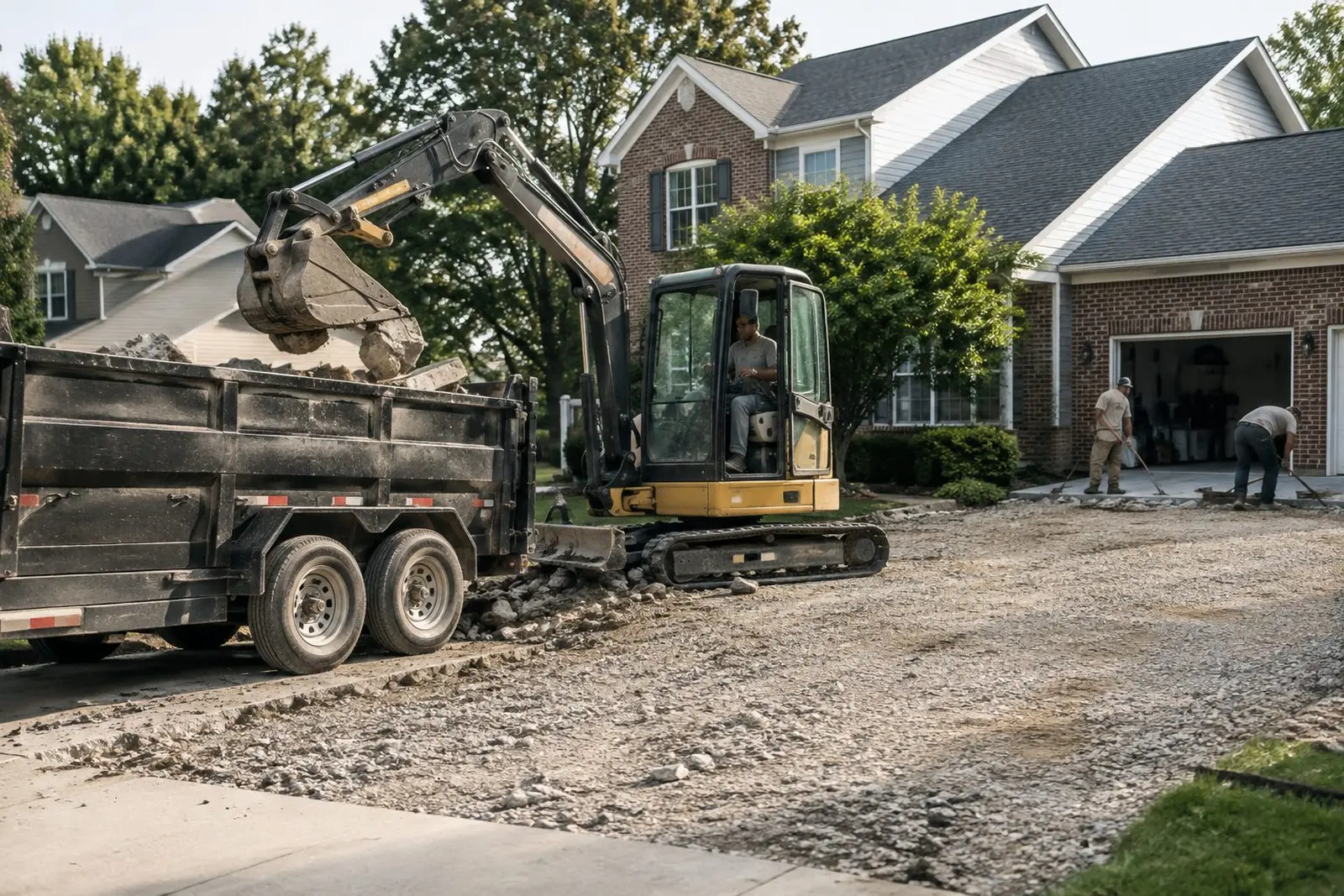
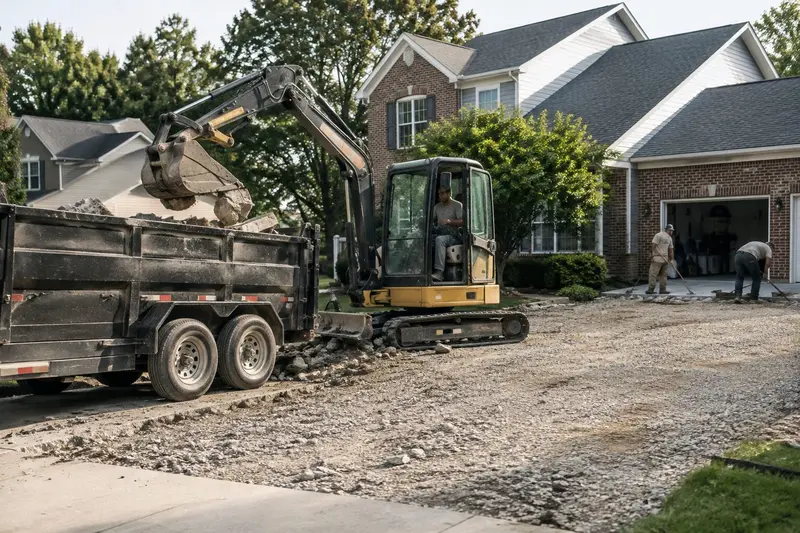
Most homeowners call a concrete contractor with one question: should I repair or replace concrete that’s cracked, sinking or flaking? The answer depends on what caused the damage, how much of the slab it covers and whether the problem is in the surface or underneath it. A patch can add years to one slab and be wasted money on the next. This guide walks through the signs worth checking, and it points to our concrete repair and removal and replacement pages if you already know which way you’re leaning.
Start With the Cause, Not the Crack
A crack is a symptom. Before deciding anything, figure out why it’s there. Shrinkage cracks show up as thin lines in the first months and often stop growing. Settling cracks come from soft or washed-out soil under the slab. Heaving comes from water freezing in Indiana clay, or from tree roots pushing up. Surface flaking usually traces back to de-icing salt or a finish that was worked too hard. Our guide to why concrete cracks in Indiana goes deeper on each one.
If the cause is still active, a repair on top won’t last. A downspout dumping water onto the slab will keep washing out the base no matter how neat the patch looks.
Signs a Repair Makes Sense
- Hairline or narrow cracks where both sides are still level
- A single damaged corner or edge on an otherwise solid slab
- Small areas of chipped or flaking surface
- One or two panels that sank as a unit but are still in one piece
That last one is often a case for concrete leveling, which lifts a settled slab back into place instead of tearing it out. Leveling works best when the slab itself is sound and the soil underneath has stopped moving.
Expect a repair to show. Patching material rarely matches the color and texture of an older slab exactly. A repair is about function first: keeping water out, removing a trip edge and slowing further damage.
Signs Replacement Is the Better Call
- Wide cracks where one side sits higher than the other
- Cracks that keep growing or branching across the slab
- Flaking or scaling over a large part of the surface
- Panels broken into several pieces or crumbling at the edges
- A slope that sends water toward the house
A useful rule of thumb: once damage covers much of a slab, repeated repairs start to add up past what a new pour would have meant. Replacement also gives you the chance to rebuild the base, correct the slope and choose a new finish.
When to Repair or Replace Concrete Panel by Panel
There’s a middle path. Most driveways, walkways and patios are made of separate panels divided by control joints. If two panels are badly damaged and the rest are sound, those two can be cut out at the joints and poured again. The trade-off is looks. New concrete starts out lighter than old concrete, and even after a few seasons it rarely matches exactly.
For a back walk, nobody minds. For the front of the house, some owners would rather replace the whole run so it reads as one surface. Neither choice is wrong. It depends on how much the patchwork would bother you.
Salt Damage and Your Warranty
Surface scaling from de-icing salt is one of the most common winter problems on Indianapolis concrete. Small areas can sometimes be repaired, but widespread scaling usually means the top layer has given up. Our de-icing salt guide covers how to keep new concrete from the same fate.
Keep in mind that our 3-year workmanship warranty covers problems caused by work done incorrectly. It doesn’t cover damage from salt or other outside causes, so winter care matters after any repair or replacement.
How We Help You Decide
Golden Paw offers both repair and full replacement, so there’s no reason to steer you toward one. At the in-person consultation we look at the slab, the soil, the drainage and the edges, explain what we think is happening and lay out your options. You get a written, itemized scope for whichever path you choose. No pressure, no upsell to a new driveway you don’t need.
Get an Honest Look at Your Concrete
Golden Paw Concrete will tell you plainly whether your slab can be saved. Call or text (317) 672-0966 or request a free estimate to book a free, in-person consultation.